
Certificate wording examples for every type of award
Copy-ready lines for ten kinds of certificate, from course completion to employee of the month, plus simple rules for tone and length so every certificate reads well.

By the Certnest team
7 min read

On this page
- 1.The five parts every certificate needs
- 2.Tone and length rules that work everywhere
- 3.Completion, CPD and attendance wording
- 4.Achievement, appreciation and employee awards
- 5.Volunteer and speaker wording
- 6.School merit wording
- 7.Common wording mistakes to avoid
- 8.A final checklist before you send
- 9.Questions and answers
Key takeaways
- Every certificate needs the same core parts: a title, the person's name, what they did, who gave it and the date.
- Keep the main line under about 25 words, so it fits on the paper and reads well on a phone.
- Match the tone to the award: formal for qualifications, warm for thanks, simple for attendance.
- Use smart fields such as {name} and {date} so one wording works for a whole list of people.
- Read the wording out loud once with a long name in it before you send.
A good design makes people look at a certificate. Good wording makes them keep it. The words tell the person what they did and why it matters, and they tell anyone else, such as an employer, exactly what the certificate means. This article gives you wording you can copy for ten common types of certificate, and a few simple rules that make any wording better.
Every example uses smart fields in curly brackets: {name}, {course}, {date}, {hours} and {org}. When you send from a list, each field is filled from that person's row, so one line of wording works for 20 people or 20,000. If you only want the short version, our guide on how to write certificate wording has the steps in five minutes.
The five parts every certificate needs
Before you think about style, check that the certificate answers five questions. Someone who has never heard of your organisation should understand it in ten seconds.
| Part | What it says | Example |
|---|---|---|
| Title | What kind of certificate this is | Certificate of Completion |
| Presentation line | A short link between title and name | This certificate is presented to |
| Name | Who earned it, spelled as they want it | {name} |
| Reason | What they did, in one sentence | for completing {course}, {hours} hours |
| Issuer and date | Who gives it and when | {org}, {date} |
On top of these five, many certificates add a signature, a credential ID and a QR code that opens the live record. Those are not wording, but they make the words believable. A digital certificate from Certnest adds the ID and the verify link for you.
Tone and length rules that work everywhere
- One main sentence. The reason line should be one sentence of about 10 to 25 words. Longer text belongs in the description on the credential page, not on the paper.
- Say what they did, not what you did. "for completing the course" is better than "we are pleased to confirm that our course was completed".
- Use plain words. "For finishing" or "for completing" reads better than "in recognition of the successful fulfilment of".
- Be specific. Add the course name, the hours, the event or the year. "For outstanding work" says little. "For leading the 2026 warehouse safety project" says a lot.
- Pick one tone. Formal and warm can both work, but mixing them in one sentence sounds odd.
- Write dates the way the reader writes them. 27 November 2026 is clear in every country. Avoid 11/12/2026, which means different days in different places.
Completion, CPD and attendance wording
Learning certificates are often read by employers and professional bodies, so clarity matters more than charm. Include the course name and, where it applies, the hours.
Course completion
Formal
This certifies that {name} has successfully completed {course}, a {hours}-hour programme delivered by {org}.
Short
Awarded to {name} for completing {course} on {date}.
With a result
Awarded to {name} for completing {course} with distinction.
If you run online courses, read our longer article on course completion certificates for online courses, and see the certificate of completion templates.
CPD and continuing education
CPD hours
{name} has completed {hours} hours of continuing professional development: {course}, provided by {org} on {date}.
With outcomes
Awarded to {name} for completing {course} ({hours} CPD hours). Learning outcomes are listed on the credential page.
Professional bodies have their own rules for CPD records, so check what your audience's body asks for. Our CPD certificates guide explains what to include, and the CPD certificate template has the fields ready.
Attendance and participation
Attendance
This certifies that {name} attended {course}, held online on {date}.
Participation
Presented to {name} for taking part in {course}, organised by {org}.
Webinar with hours
{name} attended the live webinar {course} on {date} ({hours} hours).
Attendance means someone was there. Participation suggests they took part. Completion means they finished something with a clear end. Use the word that is true, because people will read it that way. More on events in webinar attendance certificates and the certificate of attendance template.
Achievement, appreciation and employee awards
Recognition certificates are personal. They are often printed and pinned on a wall, or shared with family. Warm words are welcome here, but the reason should still be specific.
Achievement
Formal
Presented to {name} in recognition of outstanding achievement in {course}.
Specific
Awarded to {name} for scoring in the top five percent of the 2026 data analysis challenge.
Appreciation
Warm
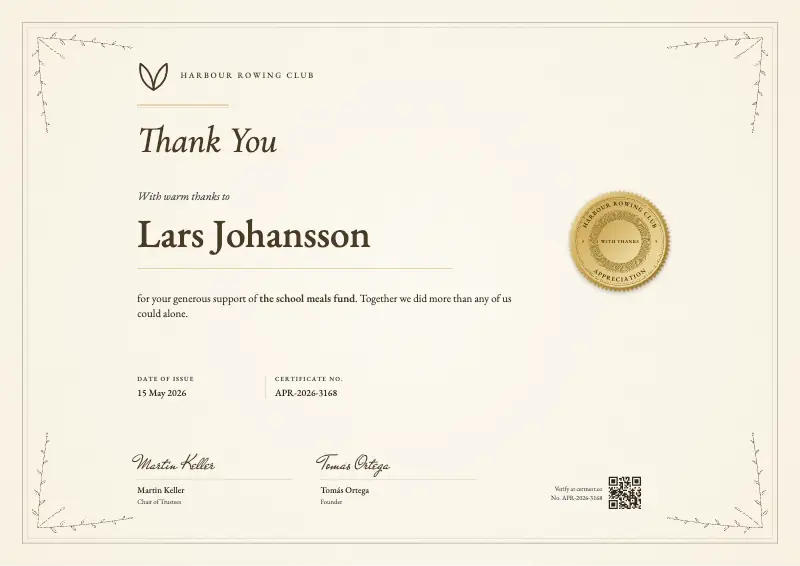
With heartfelt thanks to {name} for the time, care and energy given to {org} this year.
Formal
In appreciation of {name} for valuable contribution to {course}.
For a teacher or mentor
Thank you, {name}, for guiding our students with patience and kindness.
Employee of the month
Classic
{name} is our Employee of the Month for {date}, for dedication, teamwork and great results.
Specific
Employee of the Month, {date}: {name}, for keeping every customer order on time during our busiest season.
See the templates for achievement, appreciation and employee of the month. If you give awards often, badges can work even better than certificates: read digital badges for employee recognition.
Volunteer and speaker wording
Volunteers
Thanks
Thank you, {name}, for volunteering {hours} hours with {org}. You made {course} possible.
Formal
This certificate recognises {name} for voluntary service at {course}, {date}.
Speakers
Conference
Presented to {name} with thanks for speaking at {course} on {date}.
With the talk
{name} presented "Building Reliable Data Pipelines" at {course}, hosted by {org}.
Volunteers often use their certificates when they apply for jobs or university places, so include the hours if you track them. Templates: volunteer certificate and speaker certificate.
School merit wording
School certificates are read by students and their parents. Keep the language simple and celebrate effort as well as results.
Merit
This certificate of merit is awarded to {name} of {course} for excellent work this term.
Effort
Well done, {name}, for great effort and a positive attitude in {course}.
Ranking
Awarded to {name} for securing first place in the {course} science fair, {date}.
If your school writes certificates in Tamil, Hindi or another Indian language, you can put both languages on one certificate. Read certificates in India: GST and regional languages and see the certificate of merit template.
Common wording mistakes to avoid
- Claiming more than is true. "Certified expert" on a two-hour webinar certificate can mislead an employer. Say what happened: attended, completed, passed.
- Capital letters everywhere. A whole sentence in capitals is hard to read. Keep capitals for the title.
- Vague reasons. "For excellence" alone does not tell anyone what was excellent.
- Spelling the name wrong. Use the name exactly as the person gave it. In Certnest, recipients can ask you to fix a name, and you can correct and resend at no cost.
- Forgetting the date or the issuer. Without them, the certificate cannot be checked.
A final checklist before you send
- The title says what kind of certificate it is.
- The reason is one specific sentence.
- Smart fields match the column names in your list.
- A long name and a short name both look right in the preview.
- The date is written in words or in your readers' usual format.
- Someone who was not involved has read it once.
Questions and answers
What should I write on a certificate of completion?
Write the title, a short presentation line, the person's name, the course name, the hours if they matter, the issuer and the date. Keep the main sentence under about 25 words. For example: Awarded to {name} for completing {course} on {date}.
Is it "presented to" or "awarded to"?
Both are correct and widely used. "Awarded to" suits achievements and results, while "presented to" is a little more neutral and suits thanks and attendance. Pick one and use it across all your certificates.
How long should certificate wording be?
The main line should be one sentence of about 10 to 25 words. More detail, such as skills or learning outcomes, fits better on the digital credential page, where it does not crowd the design.
Can I use the same wording for everyone on a list?
Yes. Use smart fields such as {name}, {course} and {date}. When you send from a spreadsheet, each field is filled from the matching column for each person, so the same wording becomes a personal certificate.
What is the difference between attendance, participation and completion?
Attendance means the person was present. Participation means they took part in an activity. Completion means they finished a course or programme with a clear end, often with a test or a minimum score. Use the word that is true for your event.