
Certificates in India: regional languages, formats and GST invoices
Indian schools, colleges and training centres often need certificates in two languages, on A4, with Indian date formats, and a GST invoice for the accounts office. Here is how to get each part right.

By the Certnest team
6 min read

On this page
Key takeaways
- Bilingual certificates, in English and a regional language, are common and welcome in Indian schools and colleges.
- Write each person's name in their own script when you can, and check how long names fit.
- Use A4 paper and the day, month, year date order that Indian readers expect.
- A GST invoice for a business purchase should show both GSTINs and the right tax split, CGST and SGST or IGST.
- Verified schools, colleges and nonprofits get 30% off Certnest Pro and Business, paid in rupees.
India issues a very large number of certificates every year: school merit and sports certificates, college participation certificates, training and internship certificates, workshop and seminar certificates. Many of them need to work in more than one language, print well on standard paper and pass through an accounts office that needs a proper invoice. This guide covers the practical side of each.
Certificates in regional languages
A certificate in a student's own language feels personal, and for many families it is the version they will frame. At the same time, an English line helps the certificate travel, for example to a college or an employer in another state. That is why bilingual certificates are so common.
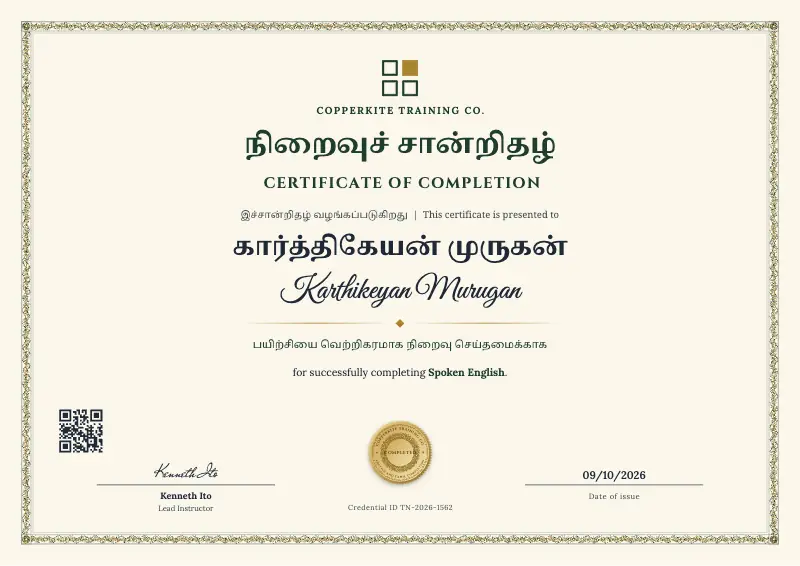
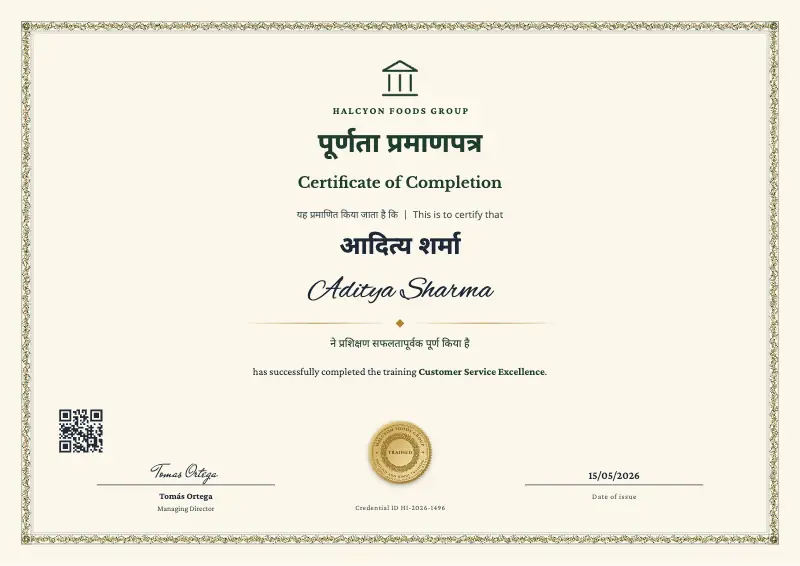
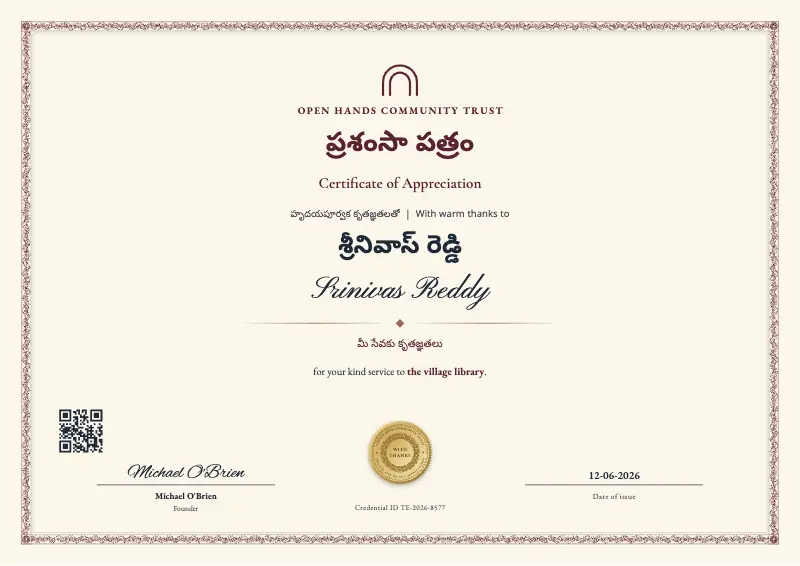
Certnest templates and pages support the major Indian scripts, including Devanagari (Hindi, Marathi and others), Tamil, Telugu, Kannada, Malayalam, Bengali, Gujarati, Gurmukhi and Odia. Fonts load only for the languages a page uses, so English pages stay light.
How to lay out a bilingual certificate
- Pick one main language. Put the title in the main language in the larger size, and the second language just above or below it.
- Keep the order the same everywhere. If Tamil comes first in the title, it should come first in the body line too.
- Give Indian scripts more room. Tamil and Malayalam words can run long, and many scripts need taller line height than English.
- Use a proper Unicode font. Old non-Unicode fonts can break when the text is copied, searched or read aloud.
For step by step help, read our guide on how to make certificates in Tamil, Hindi and other Indian scripts.
Wording that works in Indian institutions
Indian certificates often follow a familiar pattern: a formal title, a line that names the person and their class or department, the event or programme, and signatures from the head of the institution and the organiser. Here are some examples you can adapt.
School merit, formal
This is to certify that {name} of Class IX B has secured first place in the Inter-School Science Quiz held on {date}.
College participation
This certificate is awarded to {name}, Department of Computer Science, for participating in the two-day National Workshop on Data Analytics organised by {org}.
Internship
This is to certify that {name} has completed an internship of eight weeks in the Finance team at {org}, from {date}.
Training, with hours
Awarded to {name} for completing {hours} hours of training in Workplace Safety at {org}.
For many more examples by type, see certificate wording examples.
Paper size, dates and print
Most offices, schools and print shops in India use A4 paper (210 by 297 mm). Certnest sets A4 by default when your country is India, and you can switch to other sizes in the designer.
| Detail | Usual choice in India | Example |
|---|---|---|
| Paper | A4, landscape for most certificates | 297 by 210 mm |
| Date order | Day, month, year | 27 November 2026 or 27/11/2026 |
| Numbers | Indian digit grouping for large figures | 1,00,000 |
| Signatures | Principal or head, and the organiser | Two or three signature lines |
| ID | Certificate number for records | SCH-2026-0142 |
Writing the month as a word, as in "27 November 2026", avoids confusion when the certificate is read abroad, where the order of day and month can differ.
If you print certificates, test one copy on your actual printer and paper first, and keep the QR code in a plain area with a clear border. Our guide on printing certificates on A4 or Letter covers margins and bleed.
GST invoices when you buy a plan
When a school, college or company in India pays for software, the accounts team usually needs a GST invoice. If your organisation is registered for GST, a correct invoice lets you claim input tax credit on the tax you paid. Here is what a GST tax invoice generally shows.
- The supplier's name, address and GSTIN.
- An invoice number and date.
- Your organisation's name and address, and your GSTIN if you are registered. Without your GSTIN on the invoice, you cannot claim input tax credit.
- A description of the service and its SAC code.
- The value of the service before tax.
- The tax, split as CGST and SGST when supplier and buyer are in the same state, or as IGST when they are in different states.
- The place of supply.
Step 1: Have your GSTIN ready
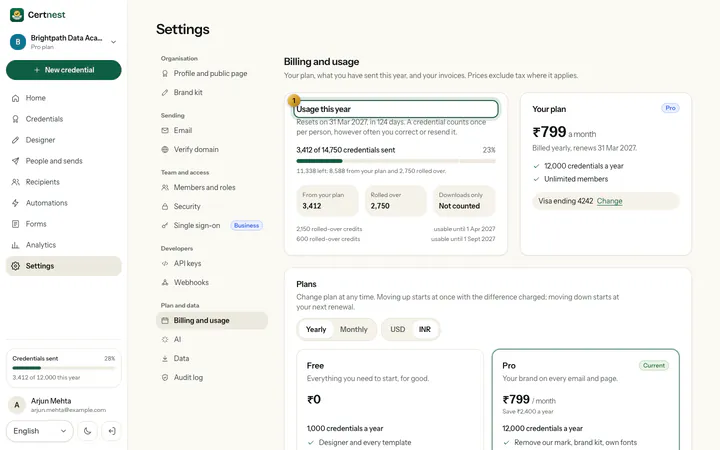
When you buy a plan, give your organisation's legal name, billing address and GSTIN, so they are printed on the invoice. Billing settings show your usage, your plan and your invoices.
Step 2: Choose to pay in rupees
Pick INR on the pricing or billing screen. Prices are shown before tax, and GST is added where it applies.
Step 3: Download the invoice
After payment, download the invoice as a PDF from the Invoices list in billing settings and send it to your accounts office.

Paying in rupees, and the education discount
Certnest has prices in Indian rupees. The Free plan includes 1,000 credentials a year with unlimited members. Pro is 799 rupees a month on a yearly plan, and Business is 3,499 rupees a month on a yearly plan. For a single event there is an Event pass for 299 rupees, once, which covers 2,000 credentials within 30 days.
Verified nonprofits, charities, schools, colleges and universities get 30% off Pro and Business. Proof of status is checked by email and the discount is set up within 2 working days. See pricing for the full details.
Students, parents and privacy
Many school certificates go to students under 18. India's Digital Personal Data Protection Act 2023 has special rules for children's data, including consent from a parent or guardian. Certnest has settings for young recipients: credential pages cannot be made public, and emails can go to a parent or guardian instead of the child. Guardian emails are deleted once they are no longer needed.
For more on schools, read credentials for schools and colleges, and for data rules in general see GDPR and recipient data.
Questions and answers
Can I make a certificate in Tamil and English together?
Yes. Start from a bilingual template, or add a second line in Tamil to any design. Names can be printed in both scripts if your list has both.
Which Indian scripts does Certnest support?
The major ones, including Devanagari, Tamil, Telugu, Kannada, Malayalam, Bengali, Gujarati, Gurmukhi and Odia. Each font loads only when a page uses that language.
What paper size should I use for certificates in India?
A4 is the standard in India, usually in landscape. Certnest uses A4 by default when your country is India.
Will I get a GST invoice?
Yes, invoices carry your tax details. Give your GSTIN when you buy, so it is printed on the invoice and you can claim input tax credit. Every invoice can be downloaded as a PDF from billing settings.
Do schools get a discount?
Yes. Verified schools, colleges, universities, nonprofits and charities get 30% off Pro and Business. We check proof of status by email and set it up within 2 working days.
Can I send certificates to parents instead of students?
Yes. With the settings for young recipients turned on, emails can go to a parent or guardian, and the credential page cannot be made public.