
CPD certificates: a practical guide for trainers and course creators
What a CPD certificate should show, how professionals use it, and how to issue one to every learner without copying names into a document by hand.

By the Certnest team
7 min read

On this page
Key takeaways
- CPD means continuing professional development: the learning professionals do to keep their skills current, often with a yearly target.
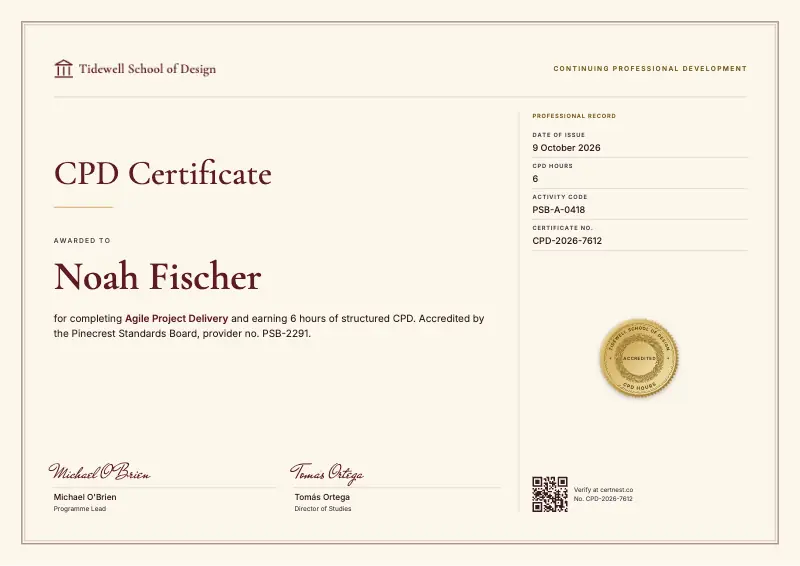
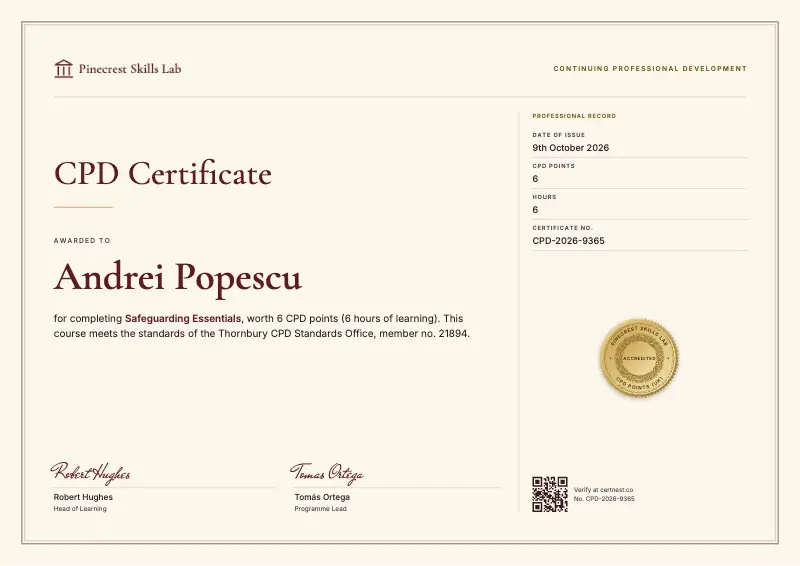
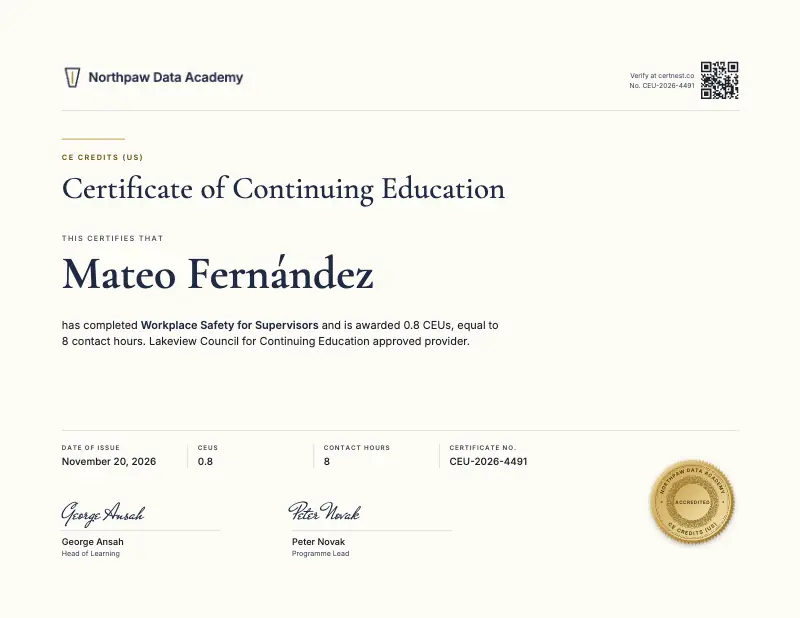
- A useful CPD certificate shows the learner, the activity, the date, the hours or points, the provider and what was learned.
- Rules differ by profession and by body, so check what your learners' bodies ask for and say it clearly on the certificate.
- Digital CPD certificates are easier to store, check and share than PDFs in an inbox.
Many professionals, from accountants and engineers to nurses, teachers and lawyers, are expected to keep learning after they qualify. In the United Kingdom and many other countries this is called continuing professional development, or CPD. In the United States the same idea is often called continuing education, or CE. Either way, learners need proof of what they did, and that proof is usually a certificate from the trainer.
If you run courses, webinars or workshops for professionals, a clear CPD certificate is part of what people pay for. This guide explains what to put on it, how learners use it, and how to send certificates to a whole group in one go. For the short version, see the step-by-step guide on how to issue CPD certificates.
What CPD is, in plain words
CPD is any structured learning that helps someone do their job better: a course, a conference session, a webinar, a workshop, reading with reflection, or mentoring. Many professional bodies ask their members to complete a number of hours or points each year and to keep a record. Some bodies check records at random. Some only ask members to keep them in case they are asked.
There is no single worldwide rule for CPD. Each profession and each body sets its own. Some count hours, some count points or credits, and some ask for a short reflection on what the learner will do differently. Some accept any relevant learning, while others only accept activities from approved providers. That is why the most useful thing a trainer can do is to make the certificate clear and complete, so the learner can match it to their own body's rules.
What a CPD certificate should show
| Field | Why it matters | Example |
|---|---|---|
| Learner's full name | Must match the name on their professional record | Kwame Mensah |
| Activity title | Says what was learned | Managing Workplace Risk |
| Type of activity | Some bodies weight types differently | Live online workshop |
| Date or dates | Places the learning in the right CPD year | 14 October 2026 |
| Hours or points | The number learners log | 3.5 CPD hours |
| Learning outcomes | Shows the learning was structured | Identify the top five site hazards |
| Provider | Who delivered and stands behind it | Harbour Line Training |
| Accreditation line | Only if true, with the body's name | Approved by the named body, reference 1234 |
| Credential ID and verify link | Lets an auditor check it in seconds | HLT-2026-0381 |
Learning outcomes and longer text do not need to crowd the printed design. On a digital certificate, the paper shows the essentials and the credential page holds the full description, outcomes, skills and criteria. Anyone who opens the link sees everything.
Hours, points and how to count them
Count only the time spent learning. For a live session, that is usually the planned length without long breaks. For self-paced online courses, give the typical time a learner needs, and say that it is an estimate. Round to the nearest half hour or quarter hour, and use the same rule on every course so learners can trust your numbers.
If you issue certificates to people in different professions, you may not know how each body converts hours to points. The safest choice is to print hours, which every system can understand, and add points only when you know the conversion for that audience.
- Write the unit every time: "3 CPD hours", not just "3".
- Use the same number on the certificate, the course page and any invoice.
- For multi-day programmes, give the total and the dates covered.
- If a learner attended only part of a live event, issue for the hours they attended, or set a minimum attendance rule before you send.
Reflection and outcomes
A growing number of bodies ask members to reflect on what they learned, not only to count time. You can help by listing two to four learning outcomes on the credential and by adding a short reflection prompt in the email or on the credential page, for example: "What will you do differently at work after this course?" Learners can copy their answer into their CPD log.
Keeping records that hold up
Learners keep their own CPD log, but providers often get asked to confirm attendance months or years later. A PDF sent once by email is easy to lose. A digital credential lives on a page with a stable link and an ID, so the learner can find it again and an auditor can check it without contacting you.
- Keep your own list of who completed what, with dates and hours.
- Give every certificate a unique ID that you can look up.
- Make sure each certificate can be verified online without an account.
- If you made a mistake, correct and reissue the same credential rather than sending a second one with a different ID.
In Certnest, every credential has its own page and ID, anyone can check it on the verify page, and the issuer can correct a name or a date and resend it at no cost. Credentials stay live after you cancel a plan, which matters for records people may need for years.
How to issue CPD certificates to a group
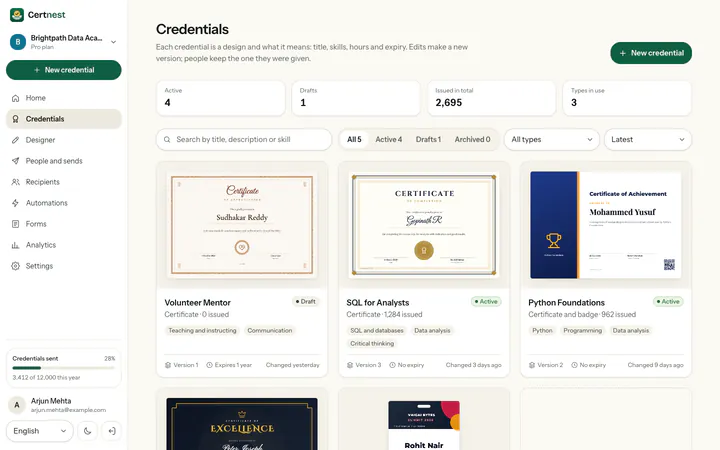
Step 1: Set up the credential once
Create a credential for the course with its title, description, learning outcomes and hours. Pick a CPD template and add your logo and colours. This becomes the record every learner gets.
Step 2: Prepare the list
Export attendance from your course or event tool into a spreadsheet with at least name and email. Add a column for hours if they differ per person.
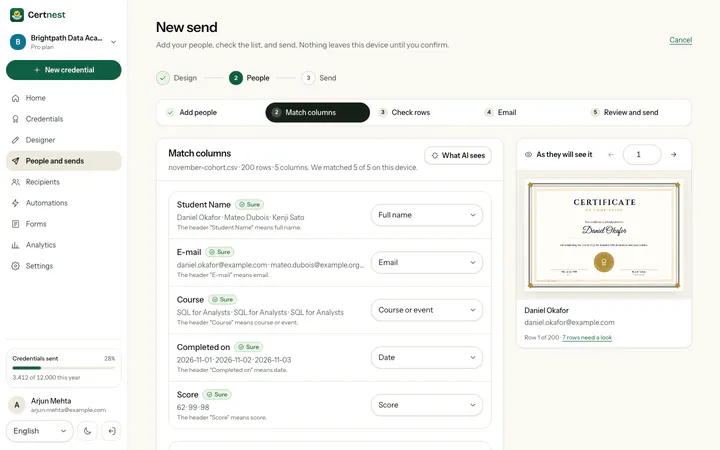
Step 3: Upload and check the rows
Upload the file. Columns are matched for you, and the checker flags missing emails, duplicates and bad addresses before anything is sent.
Step 4: Preview and send
Preview a few people, including the longest name, then send. Each learner gets an email with a link to their credential page, where they can download a PDF and add it to LinkedIn.
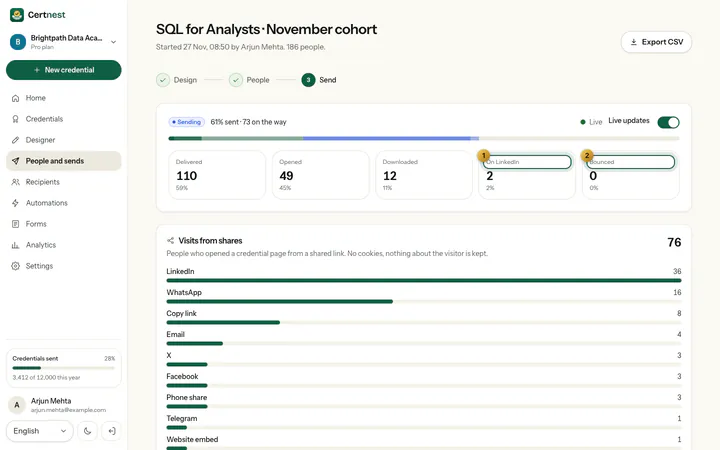
Step 5: Watch delivery
The send board shows who received, opened and downloaded their certificate, and flags any bounced emails so you can fix and resend.


For larger lists, see how to send certificates in bulk from a spreadsheet. If you run regular courses, an automation can issue the certificate when a learner completes, so you never handle the list at all.
CPD across the year
Many professionals rush to complete CPD near the end of their body's year. You can help them by offering a simple summary: a wallet where they can see every credential you have sent to their email address. In Certnest, recipients sign in to the wallet with an email code and see all their credentials from every issuer in one place.
If your own course is a certification that expires, read expiring certifications and renewals for how to set end dates and send reminders before they run out.
Questions and answers
What is a CPD certificate?
It is a record from a training provider that a professional completed a learning activity, with the date, the hours or points and what was learned. Professionals use it to log their continuing professional development for their employer or professional body.
Do I need to be accredited to issue CPD certificates?
Not always. Many bodies accept relevant learning from any provider, while some only accept approved providers. If you are not approved by a body, do not say you are: state the learning and hours clearly, and learners can record it under their own body's rules.
Should I show CPD hours or CPD points?
Hours are understood everywhere, so print hours as a rule. Add points only when you know how your learners' body converts hours to points.
How long should learners keep CPD certificates?
It depends on their body, and some ask for records over several years. A digital credential with a stable link and ID helps, because it does not depend on an old email or a lost file.
Can I issue CPD certificates automatically?
Yes. You can upload an attendance list after each session, or connect your course platform so a certificate is issued when a learner completes, with rules such as a minimum score or attendance.
What is the difference between CPD and CE?
They describe the same idea: learning after qualification. CPD is the common term in the United Kingdom and many Commonwealth countries, and CE or continuing education is common in the United States. The certificate needs the same basic facts either way.