
GDPR and recipient data: a plain guide for certificate issuers
Issuing certificates means handling people's names and emails. Here is what GDPR expects in plain words, and how to keep recipient data small, safe and easy to delete.

By the Certnest team
7 min read

On this page
Key takeaways
- When you issue certificates, your organisation is the controller of recipient data and the certificate platform is your processor.
- Collect only what the credential needs: usually a name, an email and a few chosen fields.
- Decide how long you keep data, write it down, and set it in your tools.
- Recipients can ask to see, correct or delete their data, so pick tools that make those requests easy.
- Have a data processing agreement with your platform and check its list of sub-processors.
Every certificate carries personal data. At the very least there is a name and an email address, and often there is more: a course, a score, hours of training, a photo on an ID card. If any of the people you award live in the European Union or the United Kingdom, the General Data Protection Regulation (GDPR) or the UK GDPR applies to how you handle that data. Similar laws apply in many other countries.
This guide explains the parts of GDPR that matter most to certificate issuers, in plain words. It is written for training managers, event organisers, course creators and school offices, not for lawyers.
Controller and processor, in plain words
GDPR gives two main roles to organisations that handle personal data. The controller decides why and how the data is used. The processor handles the data on the controller's behalf, following the controller's instructions.
When you issue certificates, your organisation is the controller. You decide who gets a certificate, what it says and how long it lasts. The platform you use to design and send certificates is your processor. It stores the data and sends the emails because you asked it to, and it must not use your recipients' data for its own purposes.
| Role | Who it is | What it is responsible for |
|---|---|---|
| Controller | Your organisation, the issuer | Choosing what data to collect, the lawful basis, telling recipients, answering their requests |
| Processor | Your certificate platform, for example Certnest | Keeping data safe, following your instructions, helping you answer requests, listing its sub-processors |
| Sub-processor | Services the platform uses, such as email delivery or hosting | Handling only what the platform needs to provide the service |
Certnest is the processor for the credentials you issue, and the controller only for its own account data, such as the details of the people who sign in to manage your workspace. Our privacy notice explains both.
Collect less: data minimisation
One of GDPR's core principles is data minimisation: collect only the personal data you need for your purpose. For certificates, this is easy to follow and it makes everything else simpler. Less data means less to protect, less to explain and less to delete.
- Usually needed: the person's name as it should appear, their email address, and the date.
- Often needed: the course or event, hours or credits, a credential ID, an end date if it expires.
- Only if the credential needs it: a score, a grade, a photo for an ID card, a member number.
- Rarely needed: date of birth, home address, phone number, job title. Leave these out unless there is a clear reason.
A common habit is to export a whole spreadsheet from a registration system and upload it. Instead, keep only the columns the credential uses. In Certnest, the import step matches the columns you need and you can leave the rest behind, so extra columns never reach the platform.

Your lawful basis for processing
GDPR says you need a lawful basis for using personal data. There are six in the regulation. For certificates, the ones issuers most often rely on are these:
- Contract: the person signed up for a course or event, and a certificate is part of what they get.
- Legitimate interests: you have a clear, fair reason, such as recognising staff training, and it does not override the person's interests.
- Legal obligation: some training records must be kept by law, for example certain safety training in some countries.
- Consent: used less often for certificates, but common for optional extras such as listing someone in a public registry.
Pick the basis before you send, write it down in your records, and tell recipients in your privacy notice. Using consent where another basis fits better can cause trouble, because consent can be withdrawn at any time.
How long to keep recipient data
GDPR asks you to keep personal data no longer than you need it. Certificates are unusual, because their purpose is to last. A person who earned a certificate may need to prove it many years later, and that is often in their interest.
A sensible approach separates the credential from the extra data around it:
- The credential record (name, title, date, ID, status) is kept for as long as the credential is meant to be valid, and often for good, so people can keep proving it.
- Delivery data such as bounce reports and open events can be kept for a shorter time.
- Sensitive extras such as a guardian's email for a child can be removed as soon as the email is delivered.
- Upload files such as the spreadsheet you imported do not need to be kept at all once the send is done.
Write your choices into a short retention policy and set them in your tools. Certnest has retention settings per organisation, and deleting a credential or an organisation removes the linked data.
Recipients' rights, and how to answer them
Under GDPR, people have rights over their data. The ones certificate issuers hear about most are access, correction and deletion. As the controller, you answer these requests, and your processor should help you do it quickly.
Step 1: Access: show people what you hold
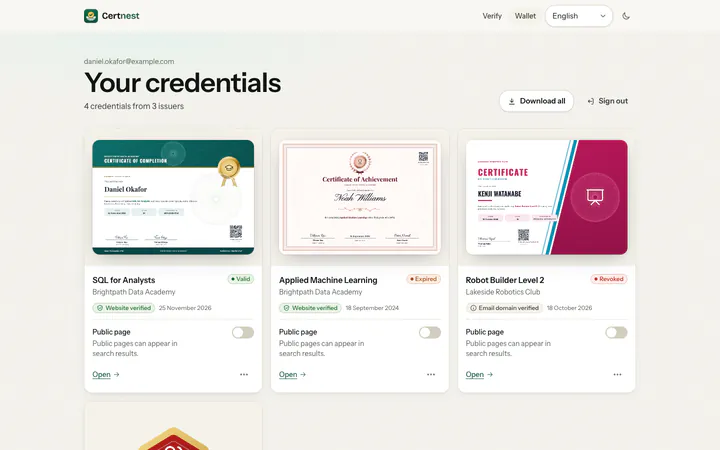
A recipient can ask for a copy of their data. In Certnest, recipients can sign in to their wallet with an email code and see every credential sent to their address, and download them.
Step 2: Correction: fix a wrong name
If a name is misspelled, the person can ask for a fix. From the wallet they can send a name correction request to the issuer, and the issuer can correct and reissue the credential at no cost.
Step 3: Deletion: remove their copy
A recipient can delete their copy from the wallet. You can also revoke or delete a credential from the recipients directory when a person asks.

Keep a simple log of requests and how you answered them. GDPR gives you one month to respond in most cases. Clear tools mean you can usually answer the same day.
Data processing agreements and sub-processors
GDPR Article 28 says a controller must have a contract with its processor that sets out what the processor may do with the data. This contract is usually called a data processing agreement, or DPA. Before you upload recipient data to any platform, check that a DPA is in place.
Also look at the list of sub-processors: the other services the platform uses, such as email delivery and hosting. You should be told about them and about changes to the list. Certnest publishes its data processing agreement and its sub-processors, including where data is stored.
Other privacy laws to know about
GDPR is the best known, but it is not the only law. If you issue certificates across borders, these are worth knowing by name:
- UK GDPR and the Data Protection Act 2018, which follow the same ideas as the EU GDPR for people in the United Kingdom.
- India's Digital Personal Data Protection Act 2023, which uses the term data fiduciary for the controller role and has rules on notice, consent and children's data.
- California's CCPA, as amended by the CPRA, and a growing number of other US state privacy laws.
- Brazil's LGPD, Canada's PIPEDA and Australia's Privacy Act, each with its own rules on notice and rights.
The good news is that the same habits work under all of them: collect little, explain clearly, keep data safe, keep it only as long as needed, and make requests easy to answer. You can read the full text of the GDPR on the official EUR-Lex site.
Issuing to schools or young people? See credentials for schools and colleges for how to handle children's data and guardian emails.
Questions and answers
Is my organisation the controller or the processor when I issue certificates?
Your organisation is the controller, because you decide who gets a certificate and what it says. The certificate platform is your processor, handling the data on your instructions.
Do I need consent to send someone a certificate?
Often not. Many issuers rely on contract, because the certificate is part of a course or event the person signed up for, or on legitimate interests. Consent is more common for optional extras such as a public registry listing.
How long can I keep certificate data?
As long as you need it for the purpose. For the credential itself, that can be a long time, because people need to prove it for years. Extra data such as upload files and delivery events should be kept for a shorter time.
What should I do if a recipient asks me to delete their data?
Check whether you have a reason to keep it, such as a legal duty to keep training records. If not, delete or revoke the credential and confirm it to the person, usually within one month.
Does Certnest offer a data processing agreement?
Yes. The DPA and the list of sub-processors are published on our legal pages, and the DPA covers every plan.
Does GDPR apply if my organisation is outside Europe?
It can. GDPR may apply when you offer courses or events to people in the EU, even if your organisation is based elsewhere. Ask an adviser about your own case.