


- API
Issue certificates and badges from Pipedream
Run a small workflow on each Certnest event, or issue from code steps.

When Pipedream
Certnest sends issue.bounced
Then Certnest
A Pipedream step looks up the right address and reissues
Every credential is signed and can be checked by anyone
Guide
How Pipedream works with Certnest
Pipedream talks to Certnest over plain HTTPS: one call to issue, and signed webhooks back when a credential is viewed, added to LinkedIn or bounced. There is no Certnest app inside Pipedream, and none is needed.
Who it is for
- Teams that build workflows with a little code
- Developers who want retries that never issue twice
What you need
- A Pipedream account
- A Certnest account, free plan included
- The ID of the credential to send (GET /credentials lists them)
- Connection
- Via webhook
- How it connects
- REST API and signed webhooks
- Set-up time
- About 20 minutes
- Category
- Automation
- Starts on
- HTTP trigger and code steps
- Plans
- Every plan, including free
Step by step
Set up Pipedream
About 20 minutes, 8 steps
Step 1: Create an API key
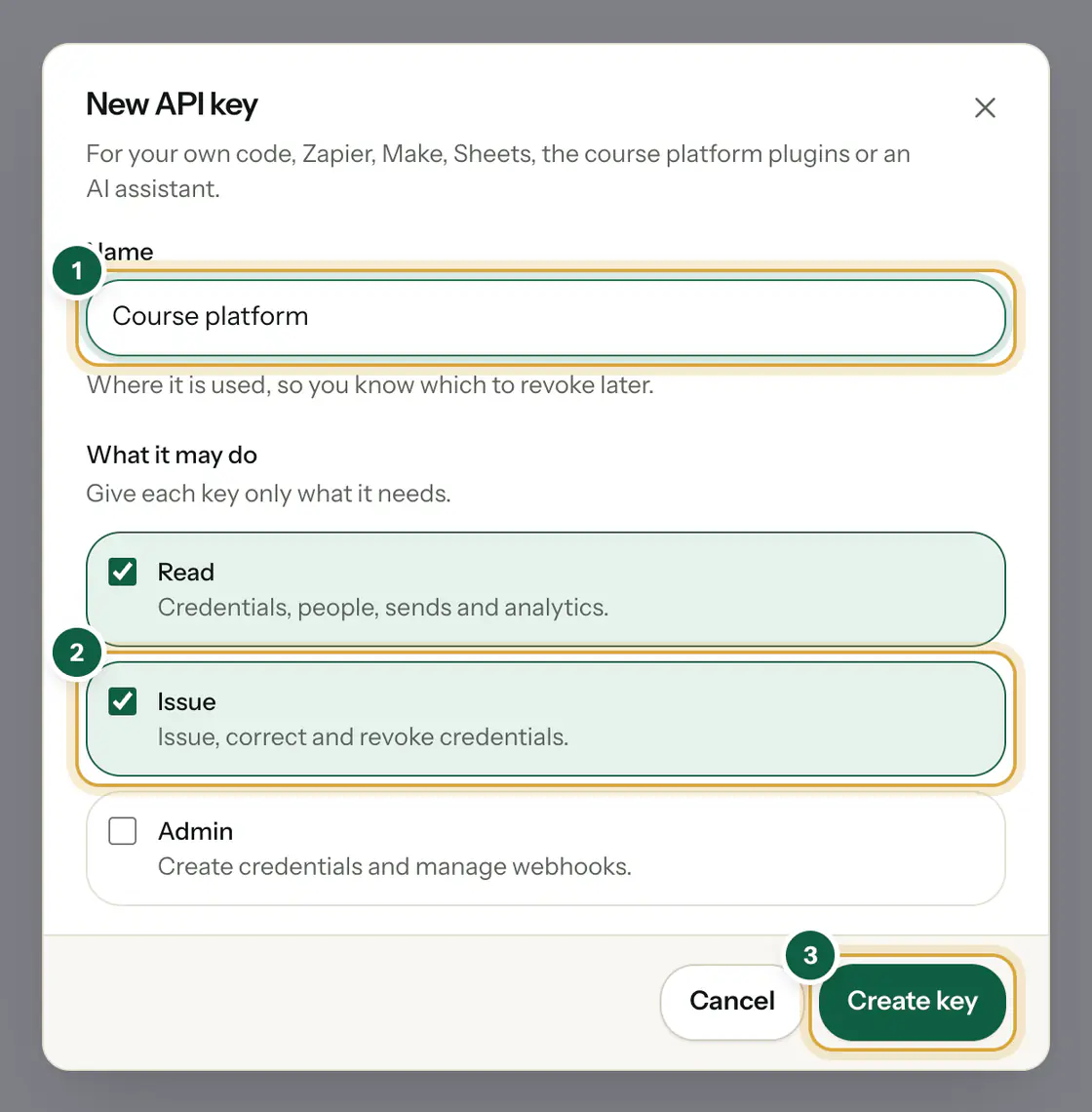
In Certnest, open Settings, API keys, New API key. Name it after where it will be used, such as "Pipedream", and make sure Issue is ticked (Read is on already). Then choose Create key.
Give each tool its own key. You can revoke one without touching the others.
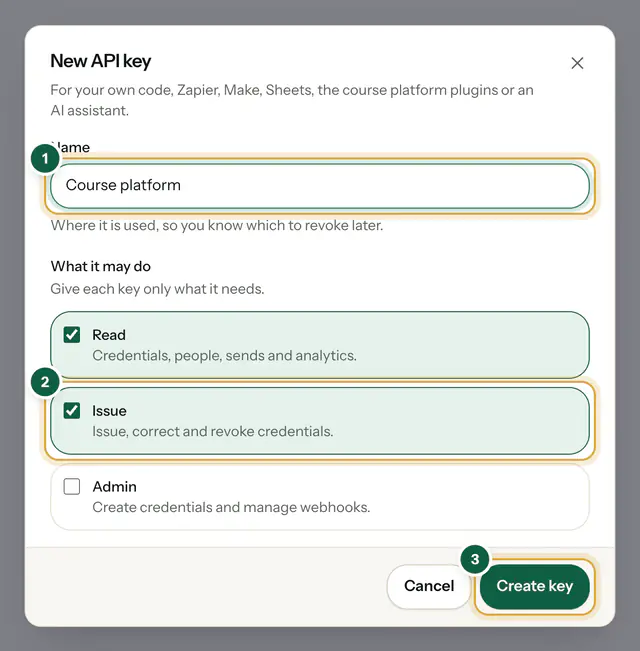
In Certnest. The New API key window in Certnest. 1: the key's name. 2: the Issue permission, ticked. 3: the Create key button. View full size Step 2: Copy the key now
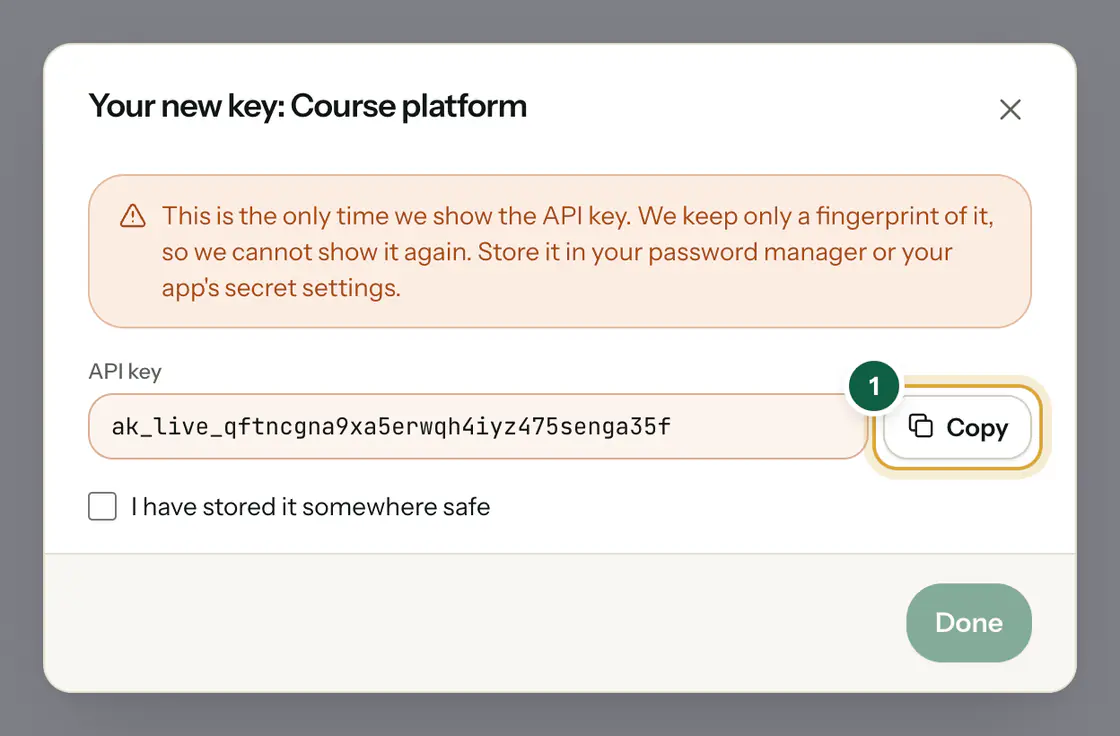
Certnest shows the key one time only and keeps just a fingerprint of it. Copy it into a password manager. If it is ever lost, rotate it in the same place and paste the new one.
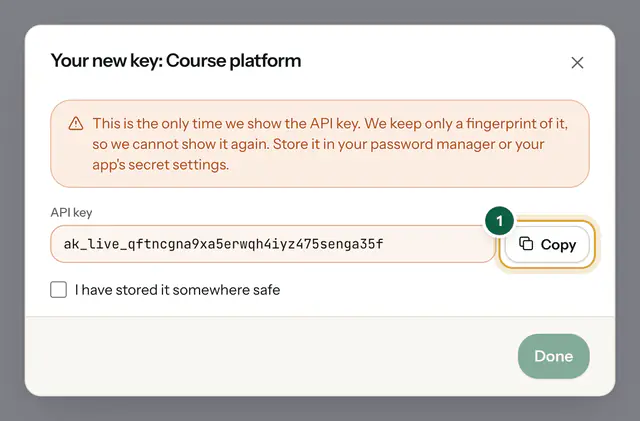
In Certnest. The window that shows a new API key once. 1: the Copy button. View full size Step 3: Add an HTTP or code step
In Pipedream, add an HTTP or code step that sends a POST to https://certnest.co/api/v1/issues with two headers: Authorization: Bearer and your key, and Idempotency-Key with an ID that is the same each time for the same person and course.
Drawing, not a screenshot. A drawing of the request: POST to the Certnest issues address with the Authorization and Idempotency-Key headers. Step 4: Send the person
The body names the credential and up to 1,000 people, each with a name, an email and your own ID. Set send email to true to email each person their link.
Drawing, not a screenshot. A drawing of the JSON body with credential_id, one recipient and send email set to true. Step 5: Read the answer
A 202 answer lists each person with their credential link. A person who already holds it comes back with duplicate set to true and is not emailed again. Retry only on 429 or 5xx answers, with the same Idempotency-Key.
Step 6: Check the first one
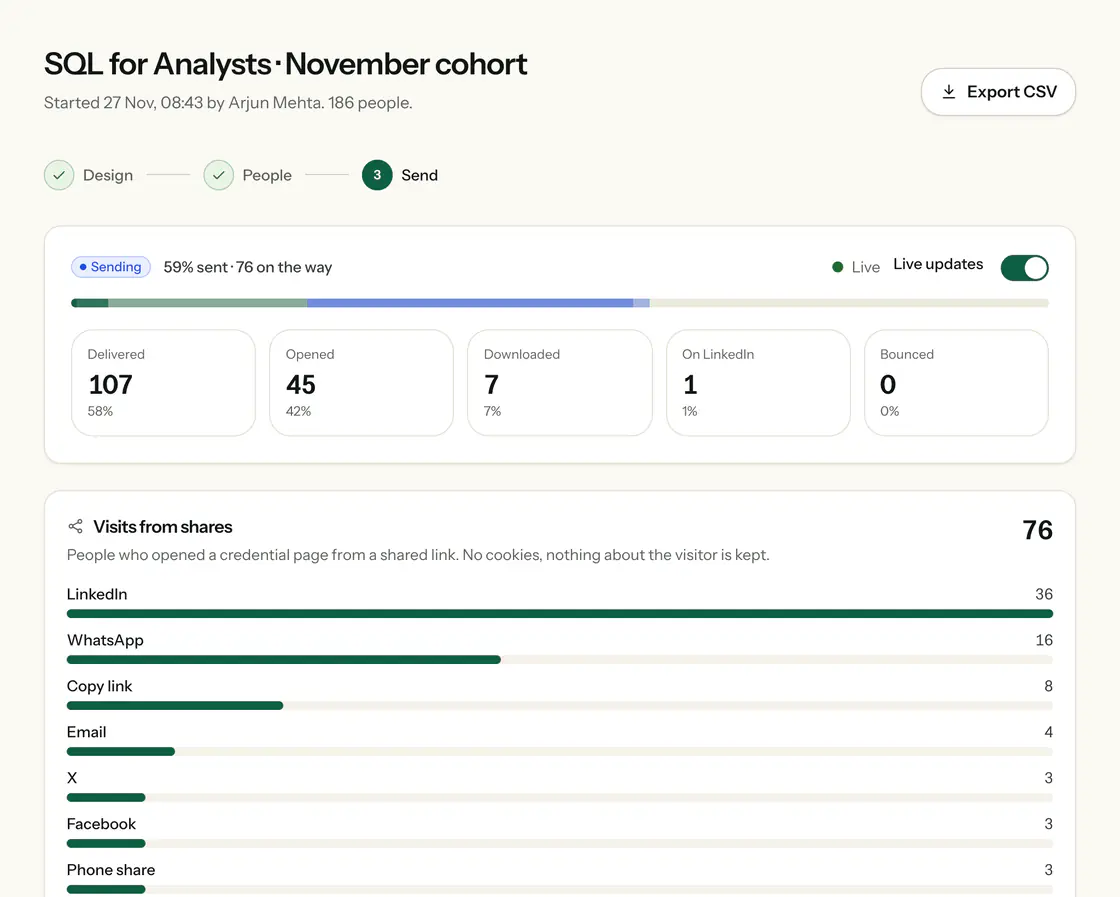
Run it once with yourself as the person. In Certnest, People and sends shows it with its status as it moves from sent to opened, downloaded and added to LinkedIn.
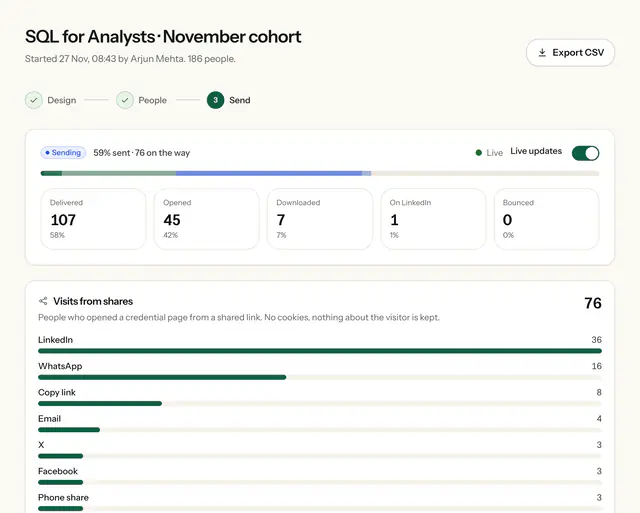
In Certnest. A send in Certnest. 1: the counts for sent, opened, downloaded and added to LinkedIn. View full size Step 7: Add a webhook endpoint in Certnest
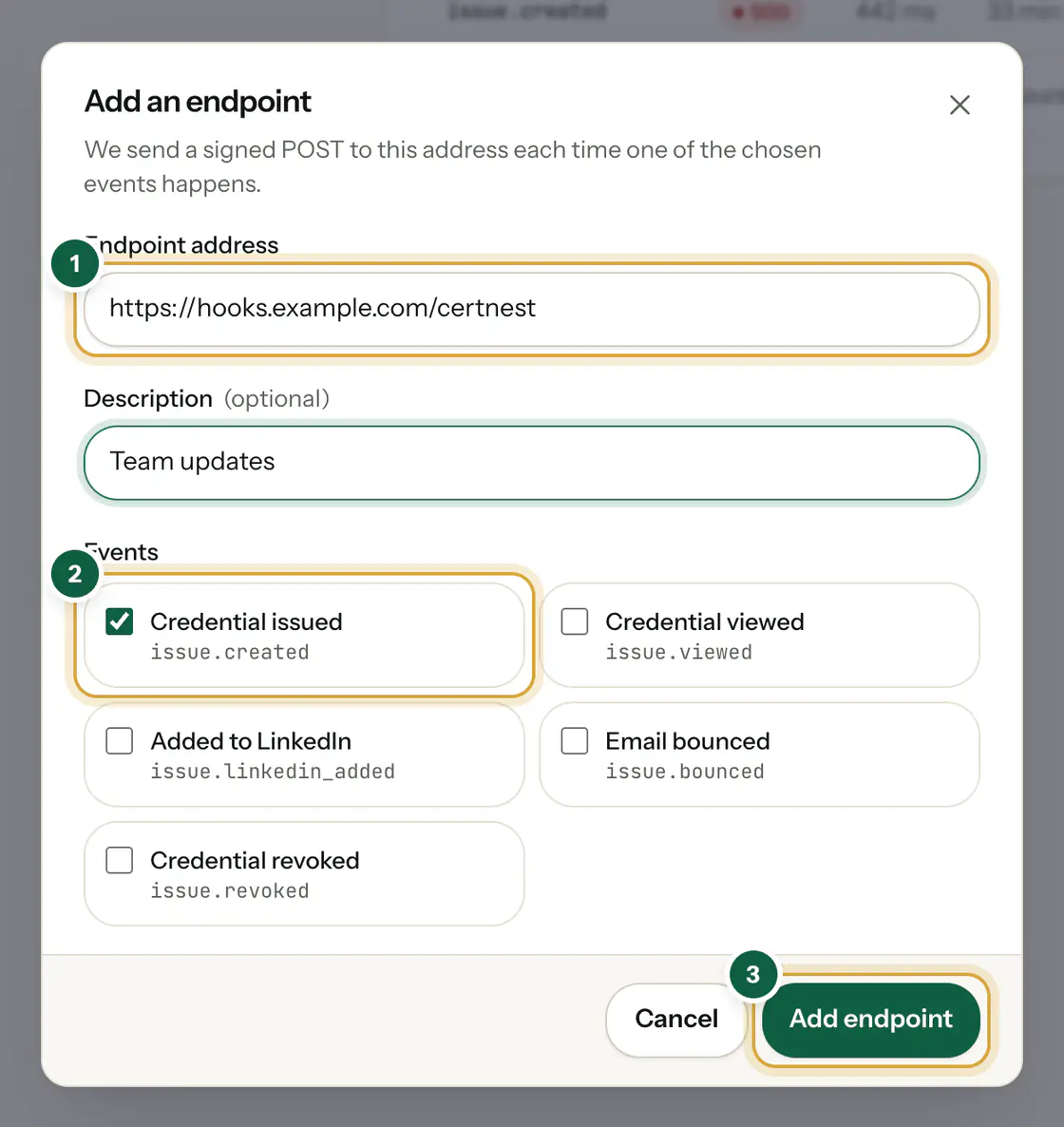
In Settings, Webhooks, choose Add endpoint. Paste the address of a Pipedream workflow with an HTTP trigger, pick the events you want and save. Copy the signing secret: it is shown once.
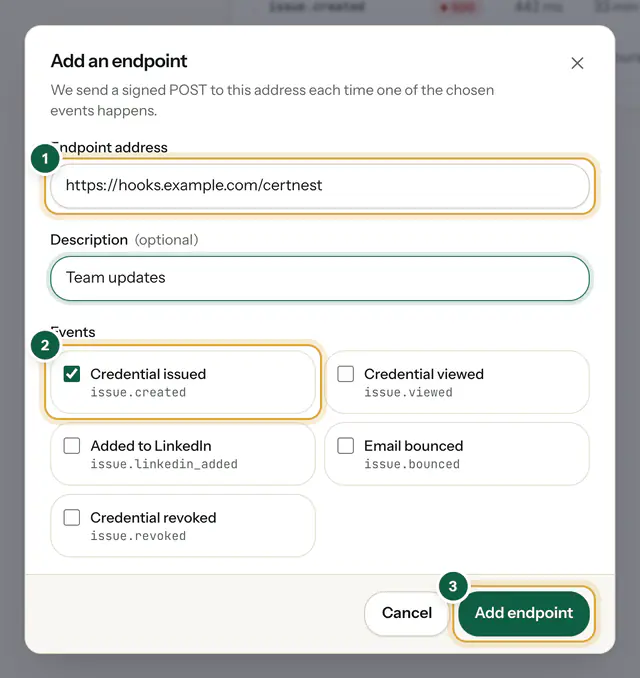
In Certnest. The Add an endpoint window. 1: the endpoint address. 2: the Credential issued event, ticked. 3: the save button. View full size Step 8: Check each signature
Every delivery has a Certnest-Signature header: t, a time, and v1, an HMAC-SHA256 of the time, a dot and the raw body, made with your secret. Compare it, and refuse anything older than five minutes.
Drawing, not a screenshot. A drawing of the signature check: build the expected HMAC from the time and raw body, compare, refuse old deliveries.


What happens next
What the person receives
Whatever starts it, everyone gets the same signed credential, ready to share.
1 of 4
An email arrives
Within moments the person gets an email from your organisation with a button to their credential. You set the sender, the words and your logo in Settings, Email.
Drawing, not a screenshot. A drawing of the email a person receives: the organisation's name, a short note and a View your certificate button. 2 of 4
Their own credential page
The button opens the credential page: the design with their name, a PDF to download and one click to add it to LinkedIn. No account is needed.
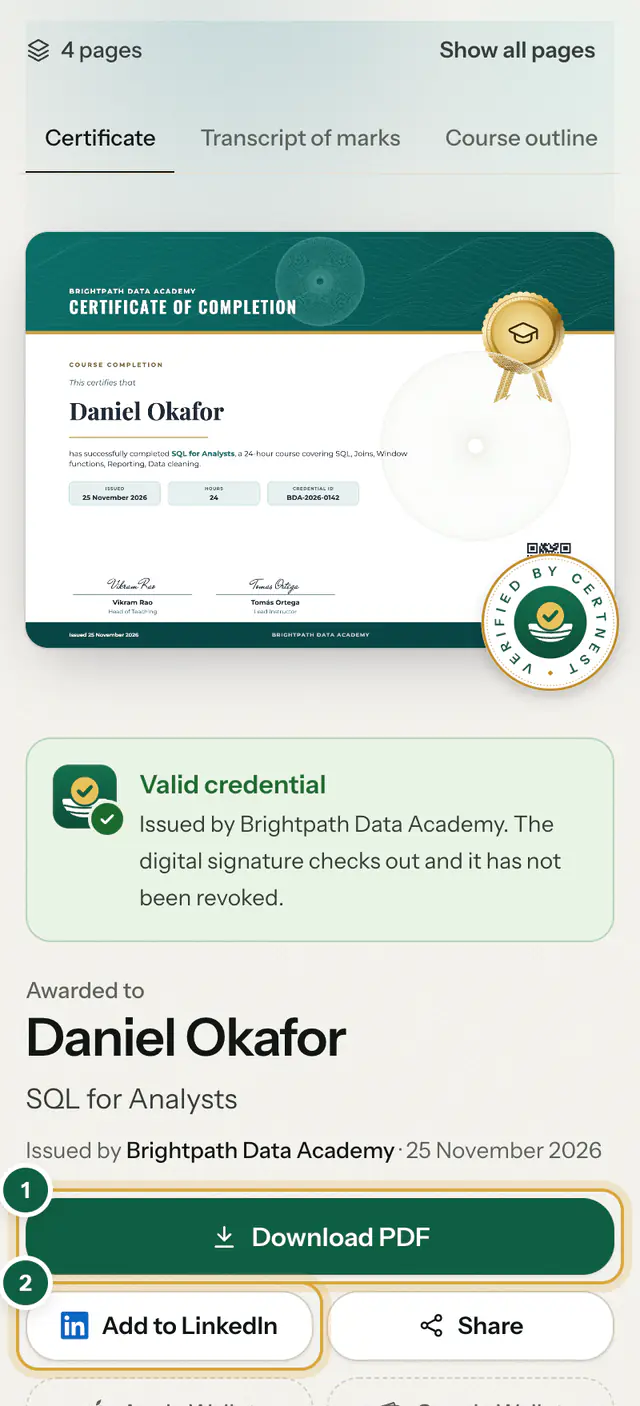
In Certnest. A credential page on a phone. 1: Download PDF. 2: Add to LinkedIn. 3 of 4
On their profile in one click
Add to LinkedIn fills in the credential name, your organisation, the date and the link, so it shows under licences and certifications.
Drawing, not a screenshot. A drawing of a profile section listing the new certificate, with the issuer and a Show credential link. 4 of 4
Anyone can check it is real
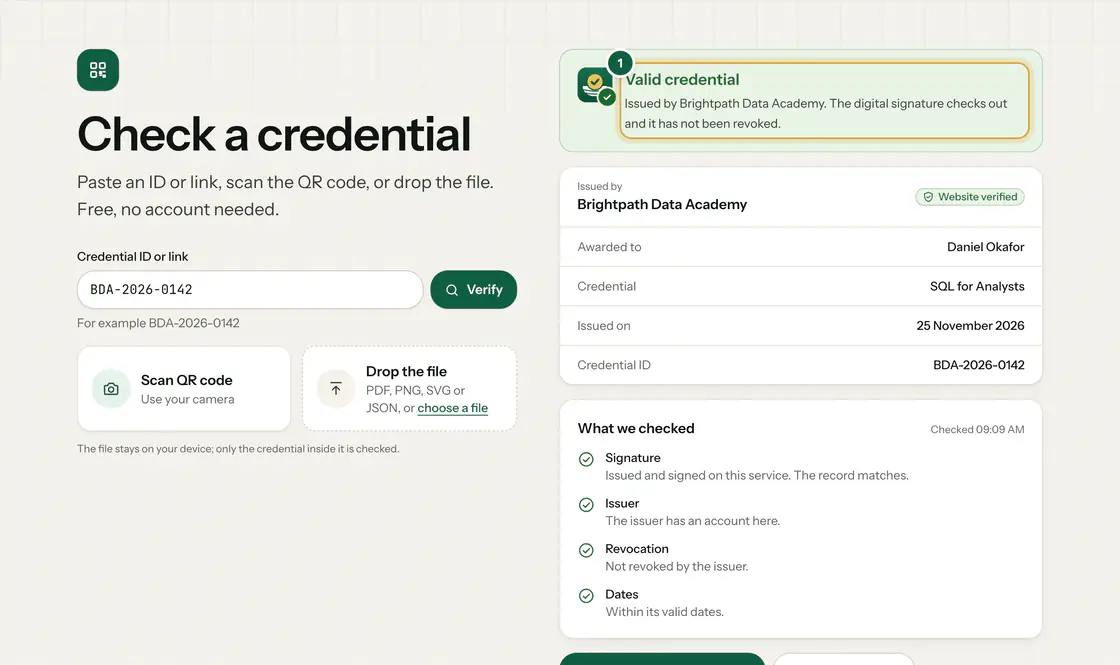
An employer opens the link or scans the QR code. Certnest checks the signature, that it was not revoked and that it has not expired.
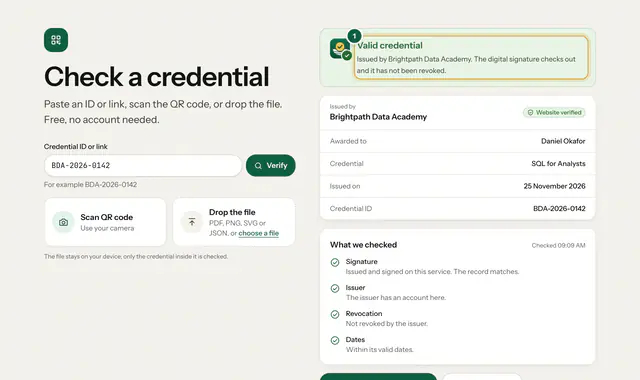
In Certnest. The verify page. 1: the result, a valid credential with the issuer named. View full size


Want to watch it happen? Try the interactive demo.
Ideas
What you can automate with Pipedream
Pipedream workflows can receive Certnest's signed webhooks on an HTTP trigger and call the REST API from a code or HTTP step. Good for teams that want a few lines of code without a server.
When Pipedream
Certnest sends issue.bounced
Then Certnest
A Pipedream step looks up the right address and reissues
When Pipedream
A payment provider confirms a course payment
Then Certnest
A code step issues the course badge
When Pipedream
Certnest sends issue.viewed
Then Certnest
Pipedream logs the view to your warehouse
Troubleshooting
If something does not work
The run log and People and sends show what happened to each person. These are the usual fixes.
401 Unauthorized
The Authorization header must be Bearer, a space, then the key. Check the key was not rotated.
422 with a message
The message says what is missing, such as an email. One bad person does not stop the others in the same call.
Signatures never match
Sign and check the raw body exactly as received, before any JSON parsing. Check the server clock is right.
Someone did not get an email
Open People and sends and find them. A bounced address shows as Bounced: fix it and send again. If Delivery is set to Issue only, nothing is emailed by design.
The same person came through twice
They still hold one credential. A person who already has a live copy gets the same one back and is not emailed again. Send a stable ID with each person to make this exact.
Pipedream questions
How does Pipedream connect to Certnest?
Through webhooks: no extra tool to pay for. Pipedream posts to a Certnest inbound address.
Does the Pipedream integration cost extra?
Integrations, the API and webhooks are on every Certnest plan, including the free plan with 1,000 credentials a year. Zapier or Make may charge for their own plans.
Can it issue the same person twice by mistake?
No. Every call carries an ID or a retry key. Someone who already holds a live copy of the credential gets the same one back, and is not emailed again.
Is Certnest partnered with Pipedream?
No. Certnest connects to Pipedream through its public features. Pipedream is a trademark of its owner, and this page does not mean they endorse Certnest.
Related
Works well with
Webhooks
NativeSigned events out, and one inbound address per automation in.
- Webhook
Zapier
NativeConnect Certnest to thousands of apps with triggers, actions and a search.
Make
NativeBuild visual scenarios that issue, revoke and react to credentials.
n8n
Via webhookIssue from an n8n workflow with the HTTP Request node, and react to signed webhooks.
- API
Pabbly Connect
Via webhookIssue with Pabbly's API step, and start workflows from Certnest's signed webhooks.
- API
Google Sheets
NativeIssue a credential for each row, and get the link and status written back.


All trademarks belong to their owners. Certnest is not affiliated with them unless stated. Logos from Simple Icons (CC0) where available.
Start issuing from Pipedream
Free for your first 1,000 credentials a year. No card needed.