


- MCP
Issue credentials from MCP server
Any assistant or agent that speaks MCP can issue and verify credentials.

When MCP server
Your support agent closes a training ticket
Then Certnest
It calls issue_credentials with confirm set
Every credential is signed and can be checked by anyone
Guide
How MCP server works with Certnest
Certnest runs a Model Context Protocol server with eleven tools and a templates resource. Hosted assistants connect to https://certnest.co/mcp and sign in with your Certnest account. Desktop assistants, code editors and your own agents can also run it locally with an API key.
Hosted clients connect to https://certnest.co/mcp and sign in. The local package is @certnest/mcp; it is published with the launch, and the setup below is exactly how it runs.
Who it is for
- Developers and teams with an MCP client or their own agent
- Code editors and desktop assistants that support MCP
What you need
- An MCP client: a remote connector with sign-in, stdio, or Streamable HTTP with a bearer key
- Node.js on the computer, for the stdio server
- A Certnest key for stdio and your own agents: Read to look things up, Issue to send, Admin to create credentials
- Connection
- Native
- How it connects
- Native MCP server, built by Certnest
- Set-up time
- About 10 minutes
- Category
- AI assistants
- Starts on
- 11 tools and a templates resource
- Plans
- Every plan, including free
Step by step
Set up MCP server
About 10 minutes, 7 steps
Step 1: Hosted clients: add the address and sign in
If your client takes a remote MCP server, add https://certnest.co/mcp. It finds the Certnest sign-in by itself (OAuth 2.1 with PKCE): sign in, pick the organisation and access, choose Allow. No key needed, so skip the next two steps.
Step 2: Create an API key
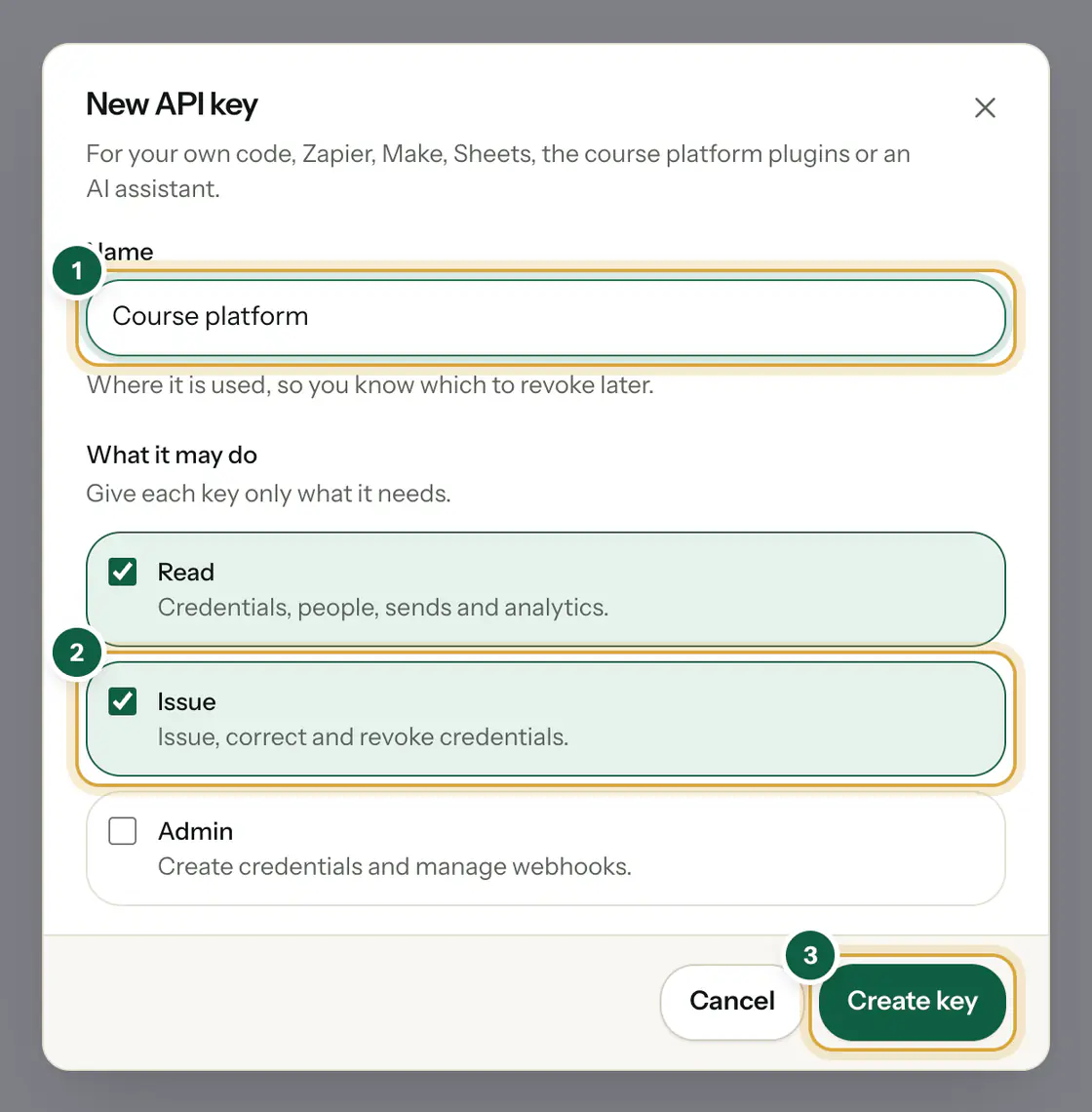
In Certnest, open Settings, API keys, New API key. Name it after where it will be used, such as "MCP server", and make sure Issue is ticked (Read is on already). Then choose Create key.
Give each tool its own key. You can revoke one without touching the others.
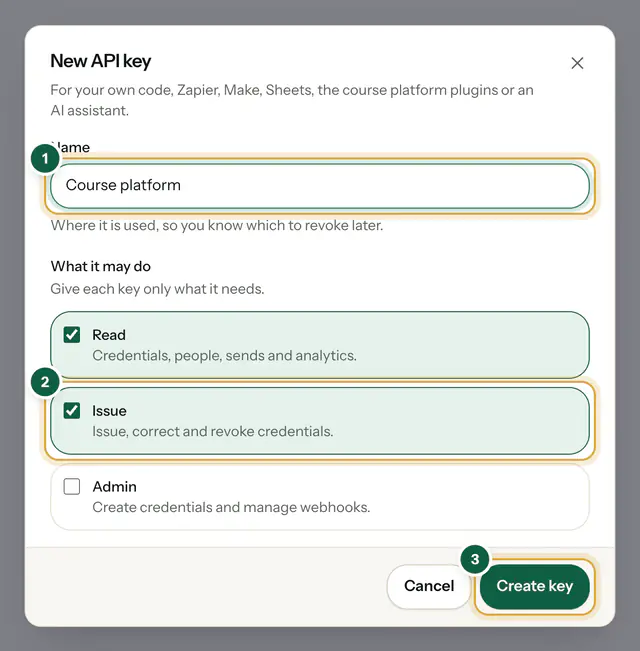
In Certnest. The New API key window in Certnest. 1: the key's name. 2: the Issue permission, ticked. 3: the Create key button. View full size Step 3: Copy the key now
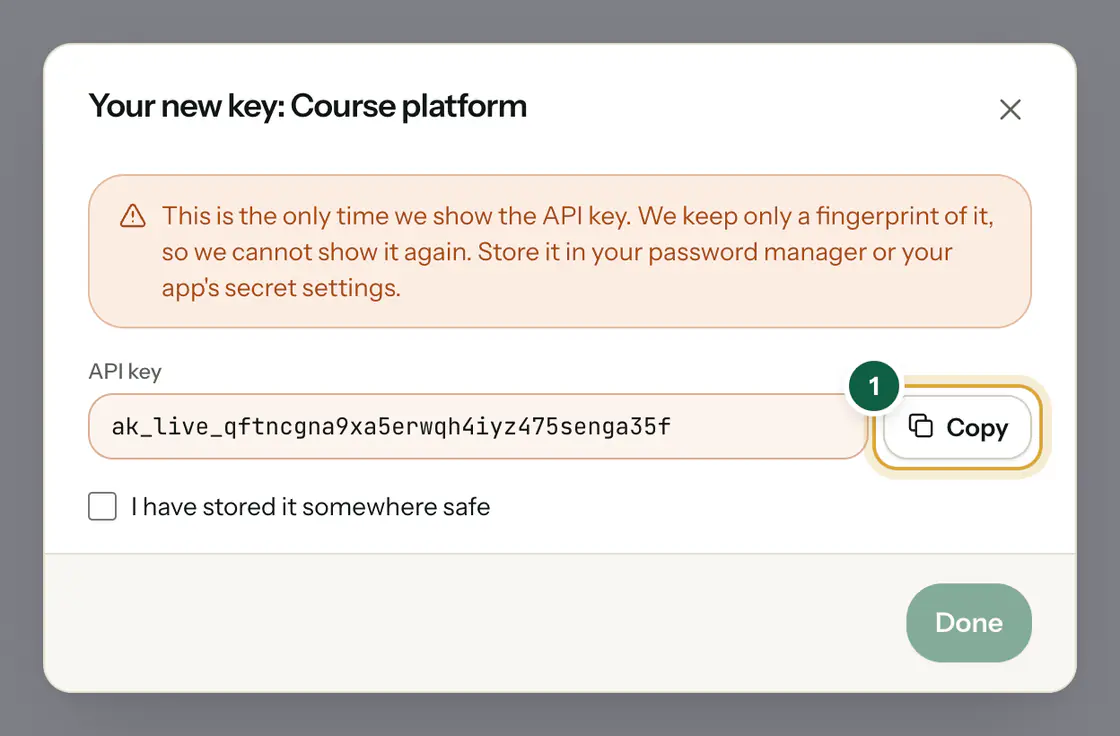
Certnest shows the key one time only and keeps just a fingerprint of it. Copy it into a password manager. If it is ever lost, rotate it in the same place and paste the new one.
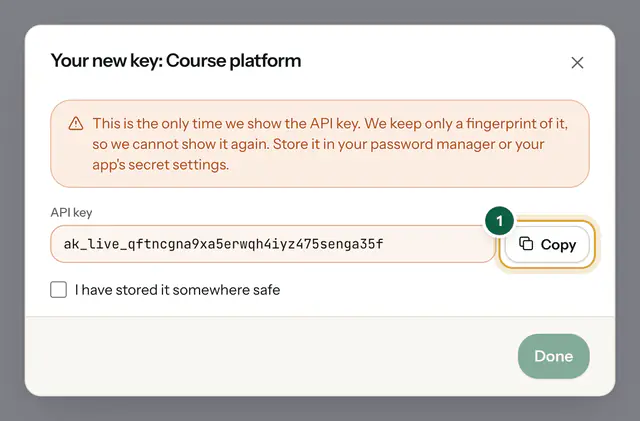
In Certnest. The window that shows a new API key once. 1: the Copy button. View full size Step 4: Add the server to your client
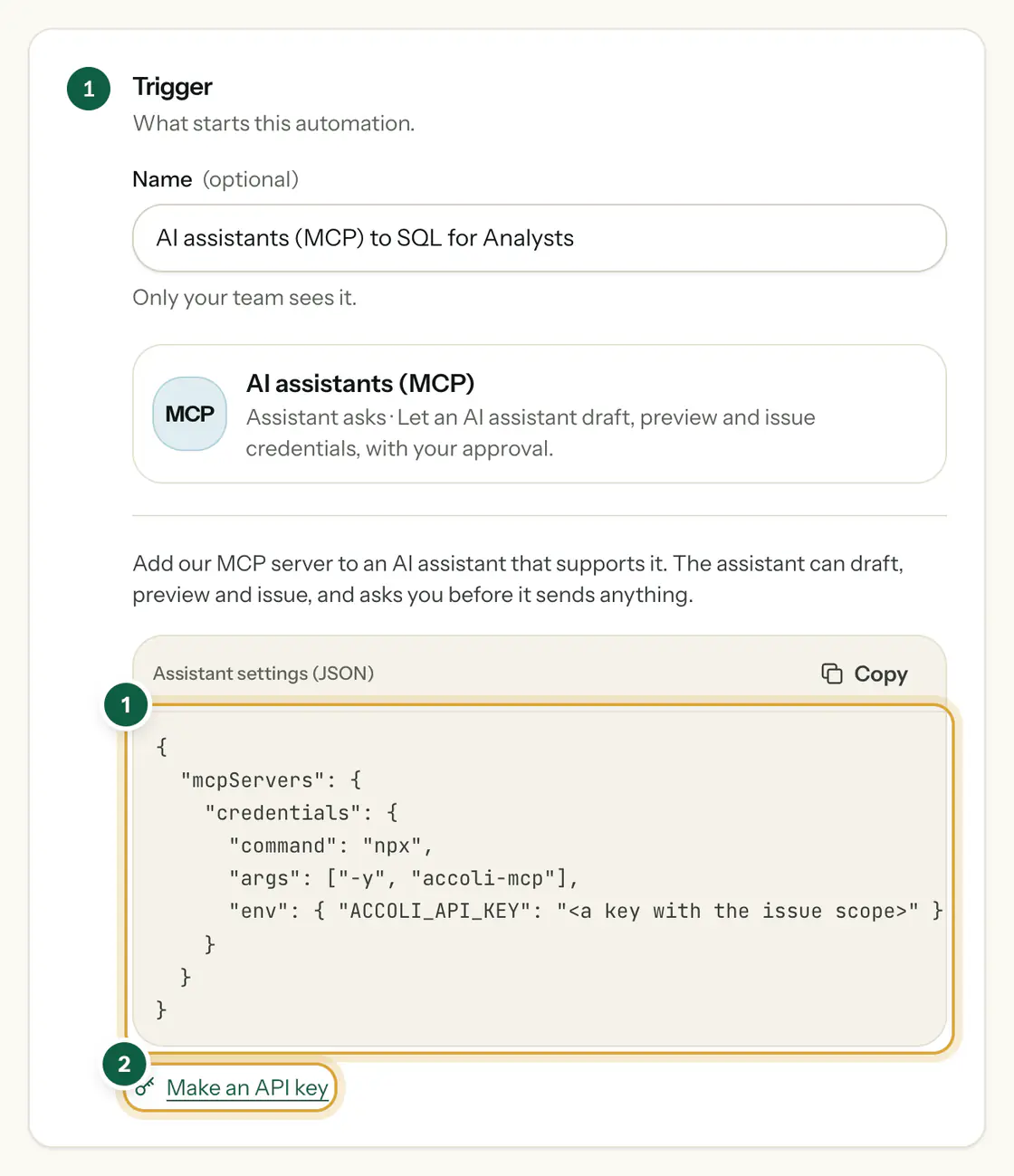
For stdio clients, run npx -y @certnest/mcp with your key in CERTNEST_API_KEY, as shown. For Streamable HTTP, send each request with Authorization: Bearer and your key.
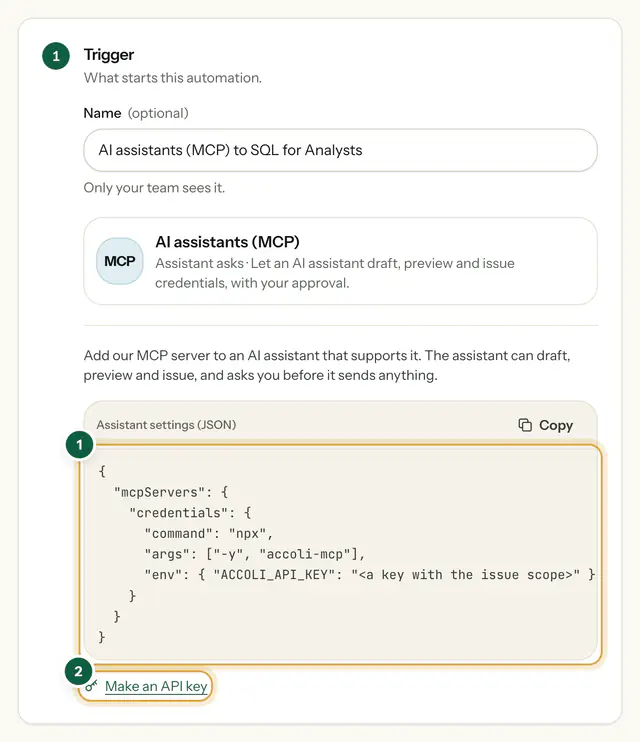
In Certnest. The AI assistants automation in Certnest. 1: the assistant settings to copy, with a place for your key. 2: the link to make an API key. View full size Step 5: Ask in plain words
Try: list my credentials. Or: send the Excel Basics certificate to the 12 people in this list. The assistant picks the right tool for you.
Drawing, not a screenshot. A drawing of a chat: a request to send a certificate to 12 people, and a preview that lists who will get it. Step 6: Eleven tools to ask for
list_credentials, create_credential_definition, issue_credentials, send_status, revoke_credential, correct_and_resend, update_expiry, export_csv, verify_credential, search_recipients and analytics_summary. Issue, revoke, corrections and end dates return a preview until confirmed.
Step 7: Check the first one
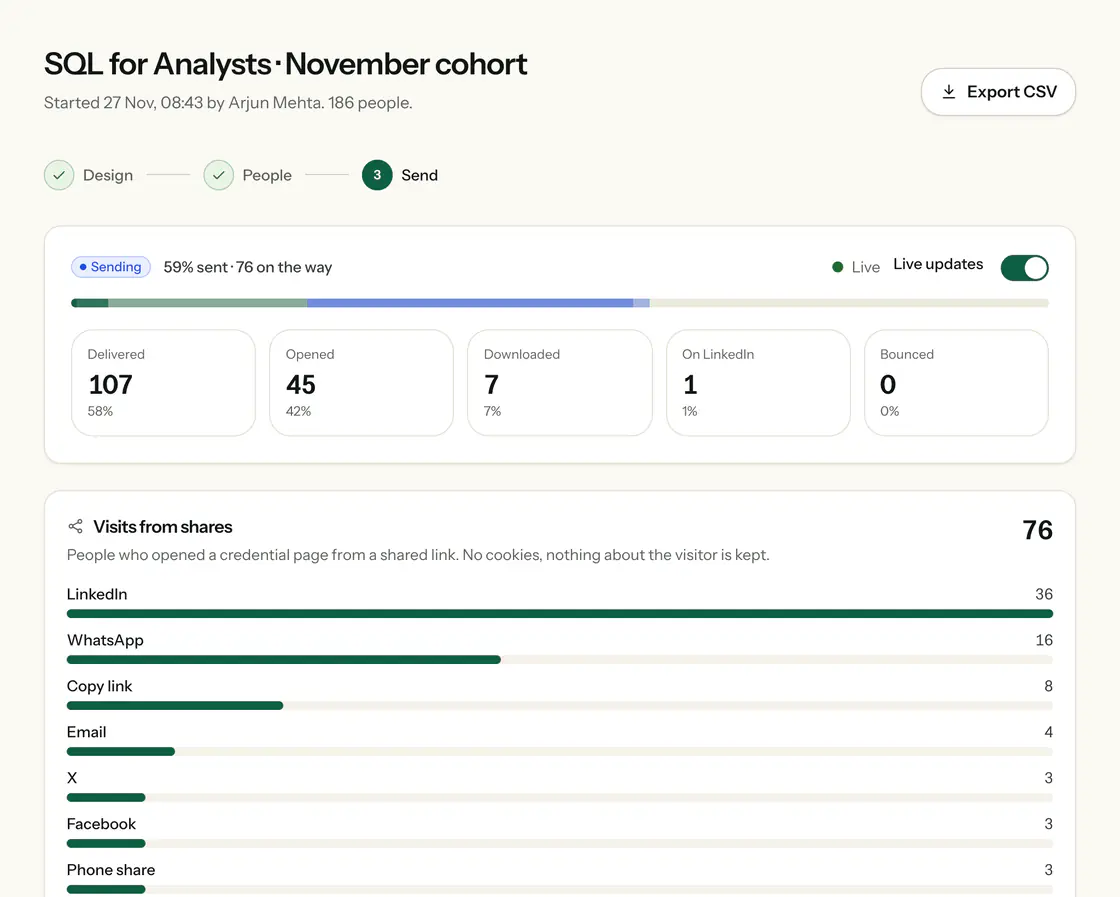
Every send the assistant makes is a normal send. In Certnest, People and sends shows it with its status as it moves from sent to opened, downloaded and added to LinkedIn.
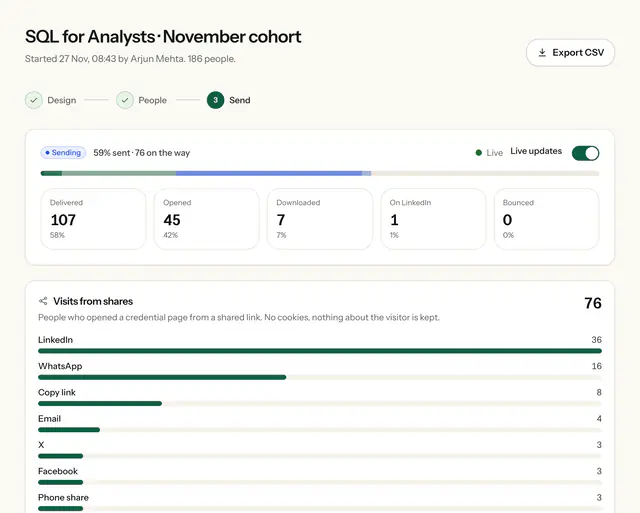
In Certnest. A send in Certnest. 1: the counts for sent, opened, downloaded and added to LinkedIn. View full size


What happens next
What the person receives
Whatever starts it, everyone gets the same signed credential, ready to share.
1 of 4
An email arrives
Within moments the person gets an email from your organisation with a button to their credential. You set the sender, the words and your logo in Settings, Email.
Drawing, not a screenshot. A drawing of the email a person receives: the organisation's name, a short note and a View your certificate button. 2 of 4
Their own credential page
The button opens the credential page: the design with their name, a PDF to download and one click to add it to LinkedIn. No account is needed.
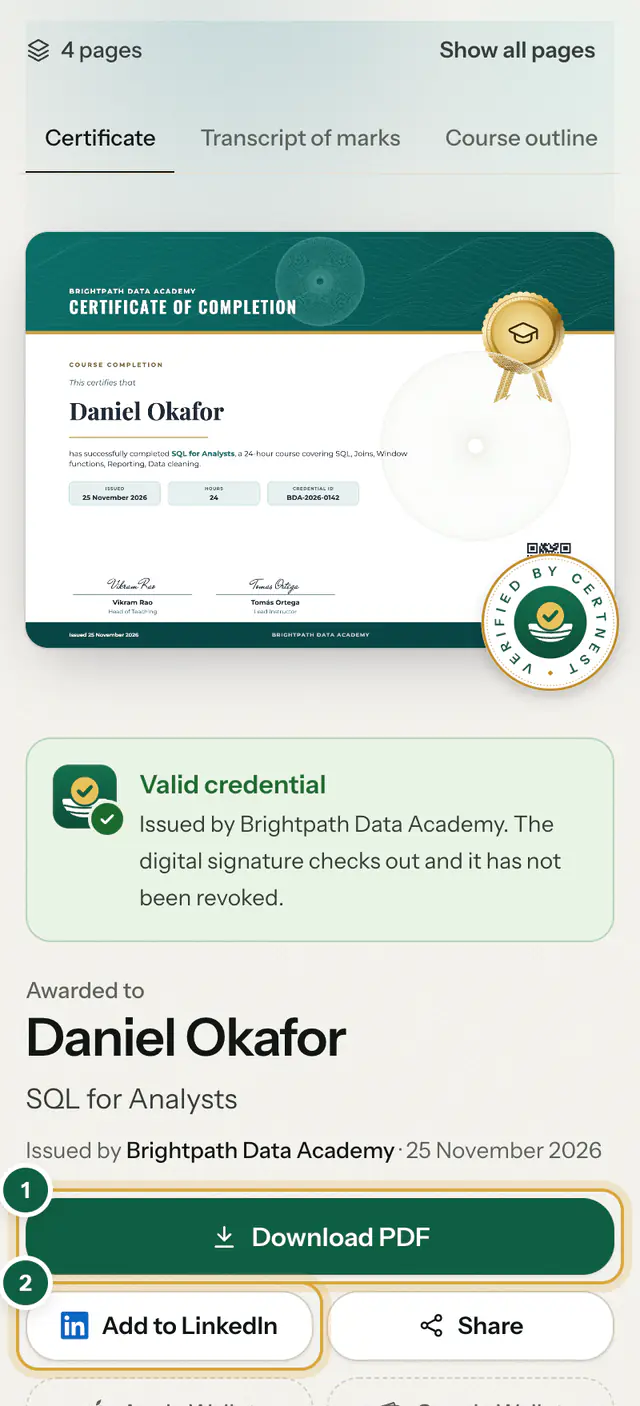
In Certnest. A credential page on a phone. 1: Download PDF. 2: Add to LinkedIn. 3 of 4
On their profile in one click
Add to LinkedIn fills in the credential name, your organisation, the date and the link, so it shows under licences and certifications.
Drawing, not a screenshot. A drawing of a profile section listing the new certificate, with the issuer and a Show credential link. 4 of 4
Anyone can check it is real
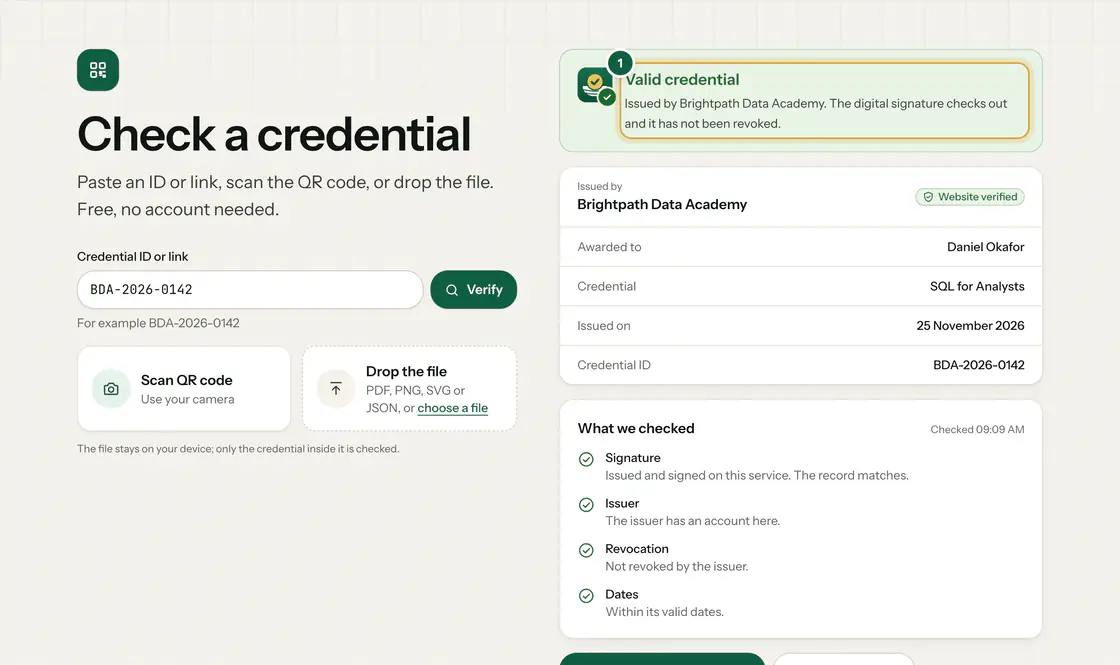
An employer opens the link or scans the QR code. Certnest checks the signature, that it was not revoked and that it has not expired.
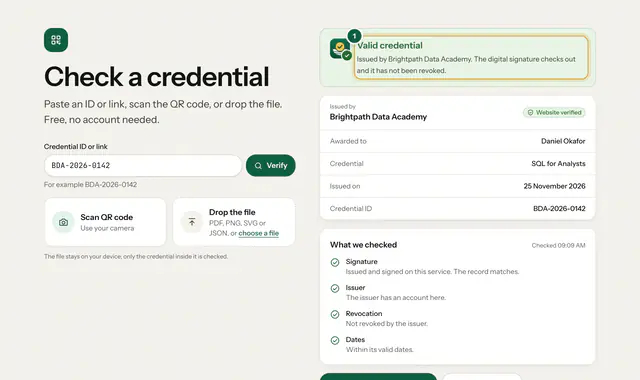
In Certnest. The verify page. 1: the result, a valid credential with the issuer named. View full size


Want to watch it happen? Try the interactive demo.
Ideas
What you can automate with MCP server
Certnest runs a Model Context Protocol server with eleven tools and a templates resource. Hosted assistants connect to https://certnest.co/mcp and sign in with your Certnest account. Desktop assistants, code editors and your own agents can also run it locally with an API key.
When MCP server
Your support agent closes a training ticket
Then Certnest
It calls issue_credentials with confirm set
When MCP server
An editor assistant is asked to check a link
Then Certnest
It calls verify_credential, which needs no key
When MCP server
A reporting agent runs on Monday
Then Certnest
It calls analytics_summary for last week
Troubleshooting
If something does not work
The run log and People and sends show what happened to each person. These are the usual fixes.
The tools do not appear
Check the config is valid JSON and restart the client fully. Node.js must be installed for the stdio server.
The assistant says it is not allowed
The key or connection lacks a permission: Issue to send or revoke, Admin to create credentials.
Someone did not get an email
Open People and sends and find them. A bounced address shows as Bounced: fix it and send again. If Delivery is set to Issue only, nothing is emailed by design.
MCP server questions
Is the MCP server integration built by Certnest?
Yes. We built and tested it ourselves.
Does the MCP server integration cost extra?
Integrations, the API and webhooks are on every Certnest plan, including the free plan with 1,000 credentials a year. Zapier or Make may charge for their own plans.
Can it issue the same person twice by mistake?
No. Every call carries an ID or a retry key. Someone who already holds a live copy of the credential gets the same one back, and is not emailed again.
Related
Works well with
Claude
NativeAsk Claude to create, issue, track and verify credentials in plain words.
- MCP
ChatGPT
NativeIssue and check credentials from a chat, through the Certnest MCP server.
- MCP
Google Sheets
NativeIssue a credential for each row, and get the link and status written back.
Google Forms
NativeSend a credential when someone submits the form and passes your rule.
Zapier
NativeConnect Certnest to thousands of apps with triggers, actions and a search.
Make
NativeBuild visual scenarios that issue, revoke and react to credentials.


All trademarks belong to their owners. Certnest is not affiliated with them unless stated. Logos from Simple Icons (CC0) where available.
Start issuing from MCP server
Free for your first 1,000 credentials a year. No card needed.